apple / spotify / pocket casts / overcast / youtube
Wass6p. It’s 🐝 yourself Friday, and this month we can finally share our episode about Chained Echoes! This is one we’ve been looking forward to doing for quite a while, and it’s also our longest episode yet! I know it’s quite a lot, but this episode was really fun and I took down extensive timestamps in the description of the podcast, so I recommend listening over the course of several sessions. I hope you enjoy it as much as we enjoyed making it!
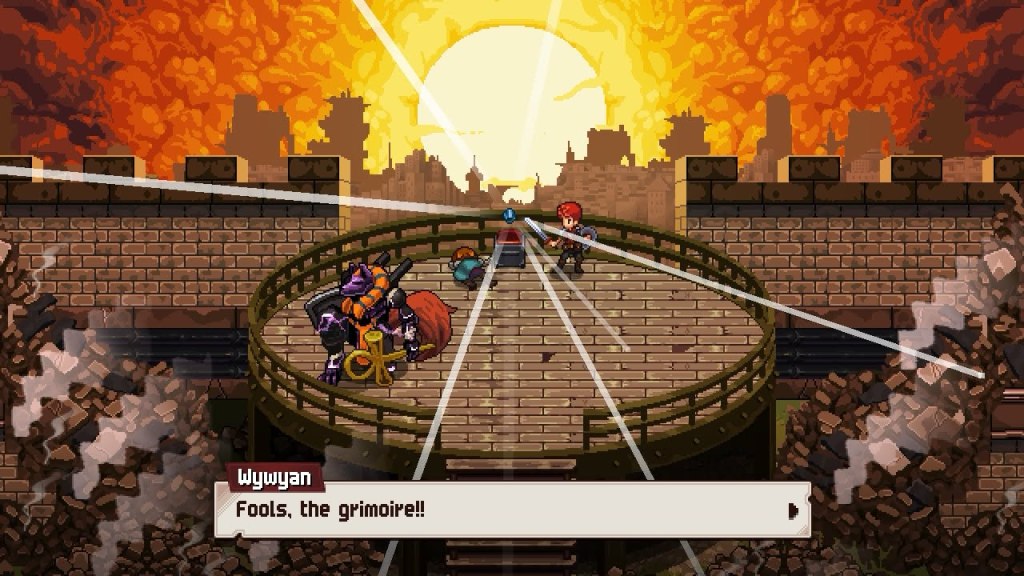
Chained Echoes is an enormous and sprawling project, especially for an indie RPG, and especially for the very small size of the team of people involved in it. What I can’t stress enough is the scope of this game and the ambition behind it: being a fully featured 40+ hour RPG with a ton of original characters and stories (and a truly incredible soundtrack by Eddie Marianukroh), Chained Echoes has a huge, expansive world with a rich history, a detailed world, a super slick and satisfying battle system, and a whole bunch of Very Cool Mechs. Inspired by the Japanese RPGs from the 1990s like Xenogears, Final Fantasy VI, and Chrono Trigger, Mathias Linda has said that he wanted to invoke how he remembers these games feeling, rather than copy them directly. The result is a game that has all sorts of aesthetic trappings and tropes from these classic RPGs while maintaining a much more modern feeling, quality and polish. It isn’t just copying these games homework though: Chained Echoes alters the formula mechanically, creating one of the more satisfying collection of battle and progression systems I’ve seen from the genre.
Systemically, Chained Echoes is a beautiful game. And I do mean that as an aesthetic piece, as it pulls from a rich history of games and inspirations, but I also mean it in the golden ratio sort of way: there is a perfect mathematical consistency to the systemic interactions at work. The progression system in Chained Echoes in particular sets itself apart from its inspirations, working in tandem with the game’s own narrative to create a tightly designed loop of gameplay and story progression that will repeat itself from beginning to end for the entirety of the game. There isn’t technically experience points or levels in this game: instead you get grimoire shards (named such after the Grand Grimoire your party chases after for most of the game). Replacing a tradition level system, grimoire shards are spent to unlock active abilities, stat boosts, and passive skills, and these shards are tightly controlled and only ever given to you after specific triggers: important story events, boss fights, and optional unique challenges completed from what the game calls the “reward board.” This means that major character and party progression isn’t gained from beating small time monsters in dungeons and fields, but is instead tethered to the things players will want to do if they take an interest in the game itself. By taking on unique challenges, seeking out difficult boss battles, and following along with the main story, your characters grow stronger, rewarding you for your interest and care rather than your propensity for crushing hundreds of goblins. This, in combination with the intentionally and carefully designed levels and world which has zero random battles, creates a system which largely eliminates most instances of grinding and rewards you for instead meeting the game where it’s at. This already satisfying progression loop benefits from a narrative that is exceptionally paced, ebbing and flowing perfectly in tune both with my desire to meander through the world and my lizard brain need to level up and get a move on to the next stunning set piece or important plot beat.
This is layered on top of the battle system (and the other battle system, the one with Very Cool Mechs) which uses a new mechanic called the “overdrive meter” to set the pace of each turn based battle and force you to use more of your abilities, characters, and skills you might not typically try. You can think of the overdrive gauge as a temperature for battle; it gets too hot, and bad things will happen to you. The overdrive meter is constantly warming up, pushing closer and closer to overheating, and once it does it debuffs your whole team and makes all of your resources more expensive. Meanwhile, every couple of turns, the meter will display the icon of a different type of skill, sometimes asking you to do an elemental attack, sometimes a heal, sometimes a buff, and so on. The only way to tick the overdrive meter back where you want it is to switch out party members in battle or use the type of skill currently being displayed, forcing you to play with a constantly shifting variety of different strategies and party members in order to stay competitive. After each battle, your health and resources refill completely and your status effects disappear, which means that each battle is a fresh start where you are encouraged and often required to use every resource at your disposal to win. Because of these systems, the battle system often functions sort of like a complex puzzle where there are lots of different answers. The huge cast of player characters provides a huge variety in strategies: maybe I should keep Lenne out and focus on magic damage, or maybe I should switch her out for Robb for poison and other debuffs? Through the course of a single battle, you’ll have to change strategies several times if you’re trying to keep the overdrive and your resources in check.
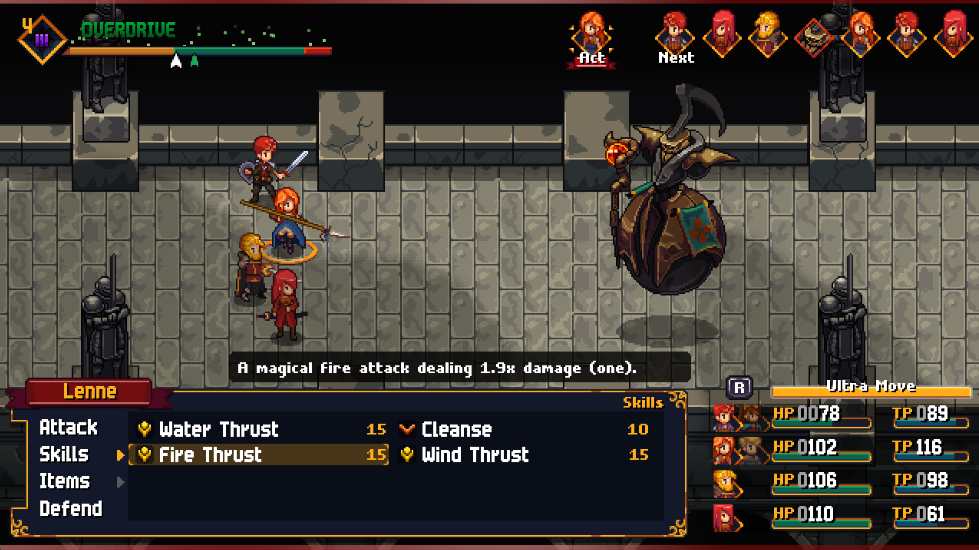
Which is to say that, as a game, systemically, I was and continue to be incredibly impressed by Chained Echoes. We spend a long time in the episode talking about how it all works and what made it click for us before we get into the spoilers section where we begin to dissect the plot and characters, and discuss what makes the game tick for us. For me, one of the big things I was looking forward to was Very Cool Mechs.
This was one of the big selling points for me. The appeal is immediately obvious. Final Fantasy and Gundam! One of those combinations that could easily be a recipe for disaster, but is still incredibly attractive to me as an idea. And it works really well as a mechanic; the battle system when you’re in your sky armor (your Very Cool Mech) is similar but different, taking the look of the regular turn-based combat but increasing the scale of everything and changing how it feels to be slightly more mechanical. The overdrive system, which on foot forces you to swap out party members and use a variety of different abilities to control it, now forces you and your party of Very Cool Mechs to switch into higher and lower performing gears to prevent overheating, which is this great mechanical flavor that feels more like piloting a vehicle. Enemies that you might have been having trouble with on foot are effortlessly crushed in the sky armor as the damage numbers go from the low hundreds into the thousands the moment you’re in the suit. Being, as we all are, a big fan of relative size, the sense of scale is much appreciated.
But being a fan of Very Cool Mechs, the way the mechs are implemented as a narrative device in this games central war becomes slightly underwhelming to me as we approach the latter half of the game, which is less focused on the horrors and political conflicts of war and more focused on the somewhat more abstract, metaphysical, god-like threats in this world. My perspective on what I want from mecha comes largely from Gundam and the stuff like it, and to me, what I think works best in shows like Gundam is a focus on war, and bodies, and the self, and the relationship between these three. Child soldiers being made implicitly by circumstance or explicitly through control to use machinery of war that makes them look bigger, stronger, and older than they are. Amuro Ray standing in the Gundam with his sights locked on Zeon soldiers outside of their mobile suits and not being able to pull the trigger, exclaiming how much easier it is when they’re in their machines — that dehumanizing distance between the person and the body when the body is a weapon of war. What I’ve also loved about it and its characters since the beginning is the focus it has on the personal and the political lives of a person in war; the relationships and rivalries between these people and pilots and soldiers sometimes on opposite sides of a battle, the respect or the hatred you feel for your enemies, the intimacy of battle.
It does not, for most of the game, feel like Chained Echoes is interested in these sorts of questions. It flirts with these ideas quite a lot in the beginning: there’s a really good encounter with a pilot named Row in the first half of the game which brings out the best of this stuff. Row is one of the Sky Armor pilots in Farnsport, and he’s seen first celebrating the end of the war in Valandis at the beginning of the game, before things go sideways. He has a personal relationship with one of our protagonists, Lenne, who he doesn’t know is secretly a princess from the kingdom on the other side of this war. He thanks her personally for having earlier brought him medicine, which saved the lives of his wife and newborn child. He tells you all about how excited he is for his daughter to be raised in a world at peace. You get the impression then that this is a rare thing for this world; for children to be raised with their fathers intact, in a time without war. Later, when the great war in Valandis begins to start once again, Row discovers Lenne’s identity and attempts to take her as a hostage, in his eyes giving his country a token they can use to bring the gears of war to a grinding stop. Unfortunately for Row, we are forced to fight, and Row tragically is killed in the battle. This is all really great stuff and its presented very well, and each character is very torn between all of their political and personal relationships. Row himself is torn, as he has a personal relationship with Lenne that is being superceded by his national identity and his longing for peace.
The trouble for me begins when Row is never mentioned a single time for the remainder of the game. Each character, and especially Lenne, seems to continue with their lives as if this whole chapter never happened. This I think is a demonstration of what I mean when I say it only flirts with these ideas: Chained Echoes is often willing to walk onto the diving board above these themes of politics and war, but it never really jumps in. His wife and his daughter never appear again, despite them being used as a device to tug at your emotions, and neither the princess who sent him on his mission nor the princess who killed him ever mention his name. Row’s absence after his death represents to me a greater absence of this thematic content it at first approaches, but then abandons as the games scope later narrows on the traditional metaphysical threats of the JRPGs it is inspired by. At the end of the day, Row is reduced from a realized character to a boss fight, and although he makes for quite a good boss fight, it is all the soldier of peace is remembered as.
But still, like I had mentioned at the beginning of this post, what I have to keep in mind about this game is the ambition behind it. This is a spectacularly large game developed by one person with the help of a very small team of artists and musicians. Each of them has done really incredible and ambitious work, and in doing they’ve made something very special. Chained Echoes swings for the fences at every chance it gets. It might miss here and there — I talk more in this episode about a similar problem with the nuclear metaphor at the heart of this game — but I appreciate that it always swings.
The next game that we’re covering on the Leaving the Party podcast is Parasite Eve! It’s our first time on the show playing a game from before the year 2000, and I’m very excited about this one. Tess and I are playing the game now, and I’ve already read the novel which it’s a sequel to (i will be doing a small book report next episode…). If you have questions about Parasite Eve or other questions you’d like us to answer on the show, please DM us on Bluesky or email us at leavingthepartypod@gmail.com. Stay tuned for next month!
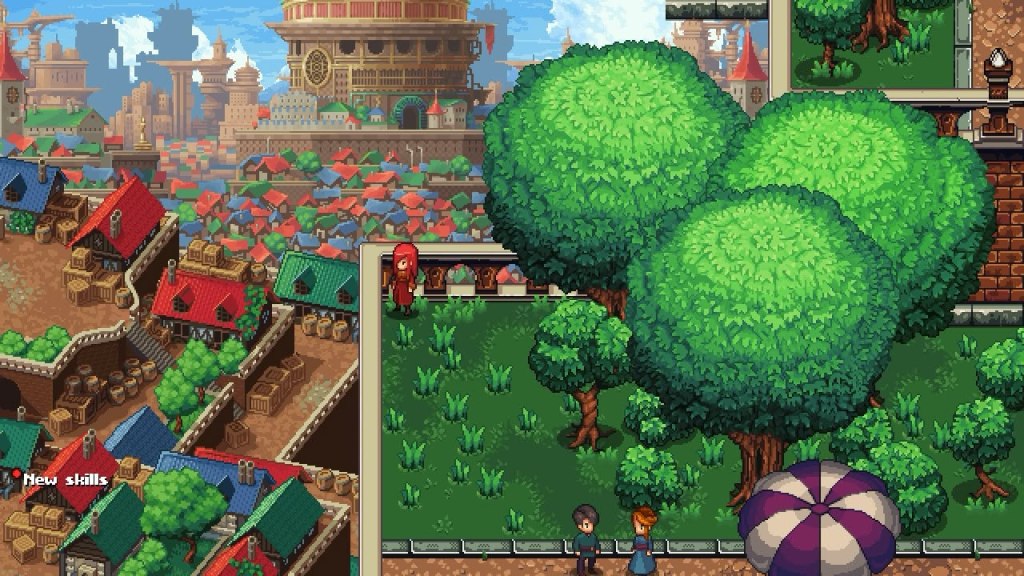
PS: there’s a really fun historical detail that i wanted to mention in the podcast but didn’t remember to. It has to do with why the catacombs of the royal family of one of the great kingdoms in Valandis was moved. Princess Amelia tells us:
Around 300 years ago, the sewer system was built in Farnsport which greatly improved the lives of the townspeople. Only the palace did not get any access to it, since under the palace lay the catacombs of our ancestors. It would have been an insult to let the feces of the palace pass through there, so for decades the royal family still had to use the old outhouse. That is until mad queen Hefnar came to power. She couldn’t bear to see the city dwellers were allowed to live a more hygienic life than she was. So despite opposition, she had the sewer system expanded into the palace. Of course, no royal wanted to be buried there anymore, Hefner least of all, so they had new catacombs built. However, it would have been an embarrassment for the court if the people learned that the old ancestral tomb had become a cesspool. Which is why they built the new catacombs far away and kept them a secret. This is probably why the church has yet to discover the tomb, even though they search for Lady Reina’s grave so eagerly.
i just think this is awesome. the inside baseball knowledge on the royal familys poop tomb. very funny and i had to put it somewhere. thanks
 leaving the party
Leave a comment