

With Resident Evil: Requiem, Capcom has sort of made two video games. One, where you play as a woman who is very afraid, is very good! The other one, where you play as a Resident Evil legacy sequel protagonist, is just okay. Does it come out in the wash? I don’t really know. What I do know is that when I’m playing the legacy sequel, I often just find myself missing the girl.
Requiem is essentially split into two halves. The first half follows Grace, a woman from the FBI who is kidnapped while investigating the site of her mothers murder, and quickly carried way over her head into a small private hospital; a secluded site of horrible human experimentation, now overrun with zombies. This, reader, is the really good part! Grace, as a character, is at the beginning of the game defined by her fear and her disempowerment, and it’s worth mentioning that her VA’s performance is stunningly good. Grace is the most anxious FBI agent there has ever been, a technical analyst way out of her depth, and Angela Sant’Albano sells her role more with every single quivering line she delivers. Grace is constantly being stalked; both narratively, by our antagonists since before the events of the game began, but then mechanically by zombies, monsters, and creatures inbetween or otherwise. As Grace, Requiem gets to really be a horror game, and some of Grace’s gameplay sections are the scariest this series has ever been! She has a gun, but more than anything it’s a deterrent used to slow zombies down enough to let you pass or to stop them if you get cornered. Her strength as a character is not in overpowering her enemies, but instead in carefully avoiding them and then outsmarting them.
There are some seriously cool design decisions that go into these sections, my favorite of which being the zombies’ own memories and habits. There isn’t a huge variety of enemy types in this first half of the game, but each zombie in the hospital still walks with latent memories of their past lives and will follow their old habits even after death, Dawn of the Dead style. In Rhodes Hill hospital, there are patient caregivers who will go around turning out the lights after hours just as they did in life, custodians who will try to clean up messes you make, doctors who will walk on instinct to the operating table, patients who are aggravated to aggression by loud noises. Every single zombie has their own unique scripting, each of them remembering simple things that were important parts of their lives before they were turned. As Grace, you can pay attention to these habits and then exploit them, use them to your advantage, and slowly gain a sort of power over this terrible hospital by knowing how to game out what your most optimal path is, and figuring out how to take pieces off of the board one by one. It still manages to be a really terrifying game when it wants to be, but it maintains this classic Resident Evil 1/2 style of systemic mastery that you get simply through really coming to know this place where you’ve been trapped.
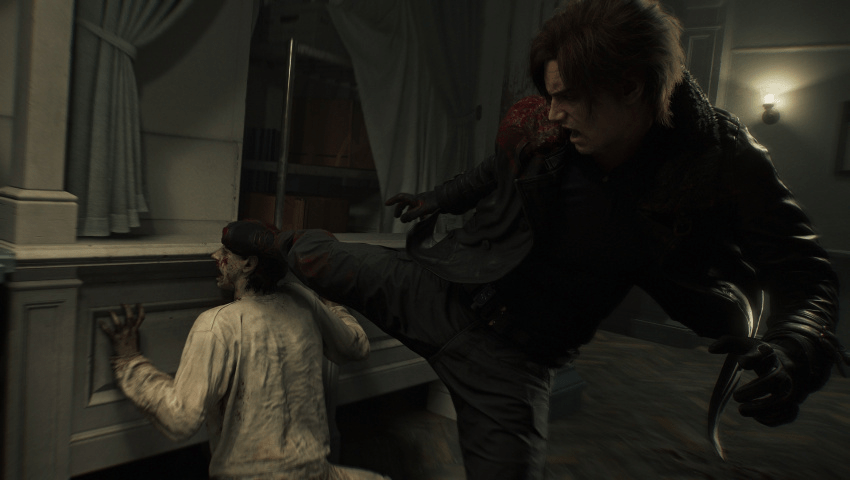
Any time you start to get exhausted of the tension and fear in Grace’s section, the game swaps to Leon’s perspective: the cool guy with funny one liners. Leon’s role in these scenes is largely catharsis and release. In comparison to Grace, Leon is a one man army; he gets a shotgun pretty early, and to illustrate his power, gets to kill one of the giant stalking monsters that Grace spent an hour running and hiding from in just a couple minutes. “Sorry,” he says, “I’m not on the menu.” Bam!!! He kills some zombie in a lab coat, and says: “I think I want a second opinion.” Boom!!! Leon allows you to take a tour de force through the hospital, and just as soon as you get used to playing as him for about 15 minutes, the game wisely switches back to Grace, where the meat of the game really lives. This is a seriously satisfying little mode of play! The first half of the game ends up being sort of a 20/80 split, 20% being Leon’s John Wick-style romp through crowds of zombies, modeled after the Resident Evil 4 Remake and 80% being Graces walking, waking nightmare, modeled more after the Resident Evil 7 style of tense, disempowered, first person horror.
My problems with the game only really start to pop up in the latter half, where Grace’s role as the protagonist isn’t just reversed: it is eclipsed. Grace is removed from the game as a playable character entirely for several hours in a row. The second half of the game follows Leon as he travels to — of course, where it all started — Raccoon City. This is where the game feels most indulgent in being “Resident Evil,” with all of the baggage that comes with, and this is where it falters as a consequence. Wesker is here! Remember that guy? Well, he’s back for some reason! Leon is back in Raccoon City once again! What do you know, he has to go back to the police station, and what do you know, the tyrant from Resident Evil 2 is back as well, and crashes through the roof! It’s a game full of callbacks like this and it feels a little bit cloying to me, feeling much more like a sequel to the series of remakes than a sequel to the new Resident Evil games that have been released since the series rebooted in 2017.
Worse, to me, is the way Leon interacts with the world. His little romps of cool guy ultraviolence are pretty fun in short bursts, but spending so much time with him like you do in this second half reveals just how dull everything feels. Leon’s primary verb he uses to interact with the world is to kill; not to delay, not to escape, not to avoid, but to destroy. This brings out the drabness of the world which was at first cleverly disguised by Grace’s much more dynamic playstyle. What made the first half of the game so powerful — the tension, the horror, the relatability, the personality of everything, even the zombies! — is made to feel flat by the barrel of Leon’s guns. Everything in the ruins of Raccoon City is a drab brown, the zombies all near-identical gaunt nobodies. People reduced to obstacles for Leon to step ontop of. Everything is in service to Leon looking cool. Leon, here, becomes the true legacy sequel protagonist: he’s the coolest, and the best, and isn’t that what you came for? To see your favorite guy from your favorite Resident Evil games, back again, looking cool?
It’s not all bad — it can actually be quite fun — but something is lost in this transition to the second half of the game, and that something is Grace, who is the reason this game works at all. Without her, the whole thing begins to fall apart while trying to stay true to the image of “Resident Evil” it now suddenly has to maintain.
There are gender politics at play here, too. Leon, the cool guy, the big man, the strong man, the fan favorite, and Grace, the scared girl, who of course becomes the mother figure to another little, scared girl. There’s of course more to it than that, and I really do think Grace proves herself to be an incredible and very capable character, but images mean things and Resident Evil Requiem is painting an image here. I think it manages to steer clear of making this comparison belittling for Grace, but the juxtaposition is intentional between them still.
Overall, maybe it does come out in the wash. At the end of Resident Evil Requiem, I ended up feeling that it was a game I actually liked a lot, something that is very rare for me in the AAA games space these days. Fitting to the title Requiem, the game feels like an homage to the direction the series has been going towards in the past decade, combining the two house styles of Resident Evil it has come to adopt ever since. Grace’s sections of the game are styled pretty heavily after the mechanics set in place by Resident Evil 7: Biohazard, the disempowerment and disorientation of Ethan Winter’s first person nightmare in the Bakers house. That feeling of being stalked, of never feeling quite safe, the horror that feels relatable to the player watching through the characters eyes in the first person, and the eventual mastery you can have over an environment that is hostile to you. Leon’s style, on the other hand being the style of the Resident Evil remakes beginning with the remake of Resident Evil 2: the third person action game, increasingly violent and tameable at the hot end of the barrel of a gun, littered with spin kicks and shotguns and funny little one liners. When Grace gets to have the driver seat, Leon subs in only for a sense of violent, joyful relief after you’re tired. But once Leon gets the idea that he’s driving, you shouldn’t expect to go back to the thoughtful, ominous horror you come to expect from Grace.
Grace does comes back in the end, and thank God she does. Her gameplay section at the end of the game manages to actually be one of the best parts! Suddenly everything is scary again, in contrast to the last several hours which had dropped the “horror” from survival horror completely! Grace is now being stalked by an old fan favorite enemy, Lickers: fleshy, lithe, muscular, skinless creatures with exposed brains who are totally blind but hunt you down with their hearing. Here they make the incredibly fun decision of putting Grace through a gauntlet with a bunch of these little fuckers and then throwing regular zombies at you in the middle, knowing that if you shoot a single zombie you’ll draw all the Lickers straight to you. At this point in the game, Grace has like 80 bullets for me, more than she could ever need, but surrounded by Lickers and forced to keep herself quiet. She can’t shoot a single one or else she’ll draw them all straight toward her and then she’s dead! It’s a little irony that turns into a really tense section and one of my favorite moments in the game. Leon, on the other hand, gets an equivalent section where his game briefly turns into an honest to god third person cover shooter, where he has to kill actual, human guys with guns and tactical gear rather than zombies and monsters. Maybe this is just me, but if you fight someone with a gun in a Resident Evil game, it should be either a zombie with a machine gun who can’t aim, or a zombie who inexplicably has a bazooka. If I wanted to fight humans in tactical gear, I wouldn’t be playing Resident Evil.
Don’t get me wrong, I love Leon. He’s a character I really love, and I still to this day think Resident Evil 4 is one of the best games of all time. I just wish that the juxtaposition between their two halves of the game didn’t make me feel so low on him. Instead, what we have is a really strong showing from a really great new character, and a really lack luster and indulgent showing from a fan favorite. That’s sequels for ya!
 leaving the party
Leave a comment